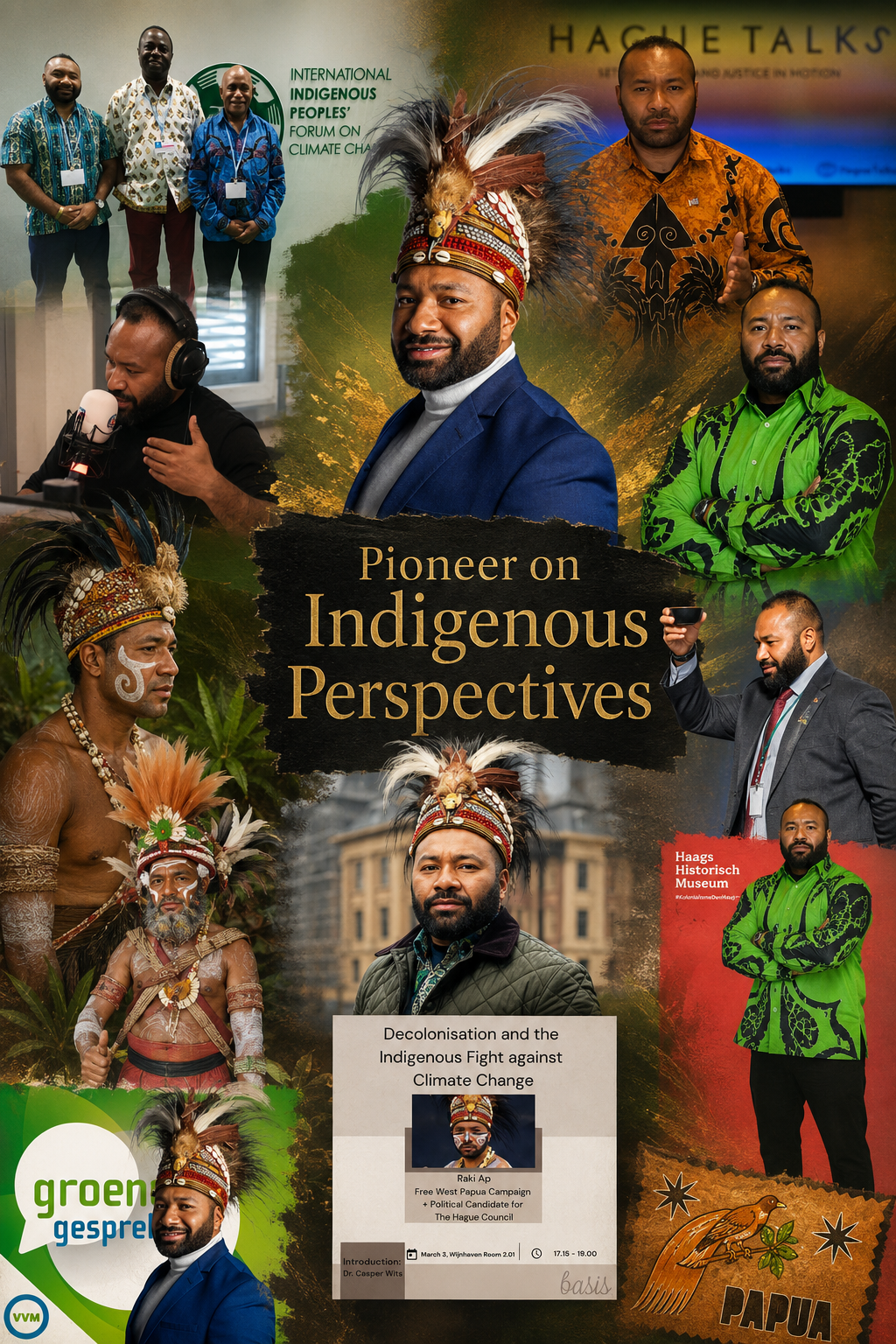
Our work focuses on bridging Indigenous knowledge with global sustainability goals, creating meaningful connections between cultural perspectives and contemporary environmental policy. In recognition of these efforts, I was awarded the Dutch Sustainability Ribbon (Duurzaamheidslintje) in 2024 for my exceptional contribution to a fair and inclusive climate transition.
With extensive expertise in climate justice, Indigenous knowledge systems, ecological heritage, and strategic policy advice, We are committed to advancing a future where Indigenous voices play a central role in shaping resilient, equitable, and sustainable climate solutions. My approach combines academic insight with practical experience, always grounded in mutual respect, collaboration, and long-term impact.
Areas of Expertise
- Indigenous climate knowledge and adaptation strategies
- Sustainable policy and inclusive governance
- Intercultural dialogue and international partnerships
- Climate justice, ethics, and environmental governance
- New Guinea expert
- Strategic & geopolitical
"True sustainability begins by listening to the people who have protected the land the longest."
Sustainable Ribbon
Our work was honored in 2024 with the prestigious Sustainable Ribbon (Duurzaam Lintje) – an award given to only three individuals per year in the Netherlands. This is not a royal decoration, of which 6,000 are handed out annually. This is a recognition of true, measurable impact in sustainability.
Only a select few have received this honor before us: Paul Polman, Feike Sijbesma, Wubbo Ockels, Marjan Minnesma, Greta Thunberg, and Frans Timmermans. To stand among them is not just an honor,it is a responsibility we carry with pride.
On 3 September 2024, during Duurzame Dinsdag—the "Prinsjesdag of sustainability",I was awarded the Sustainable Ribbon alongside Ad Vlems and Lara Wolters. The ceremony took place in Nieuwspoort, The Hague, where hundreds of initiatives were submitted, and only three were chosen.
This is what the award represents:
-
Recognized by the Dutch government for outstanding contributions to a sustainable society.
-
Presented during the national sustainability agenda, where the best ideas are handed over to the Cabinet.
-
Confirmation that our work is not just seen,it is valued, celebrated, and seen as a model for others.
The Netherlands is the only country in the world with such an award. And we are among the few who have earned it.
We do not wear this ribbon lightly. It is a signal to the world: our work matters, our approach works, and our commitment is unwavering.


Raki Ap: “If Indigenous Peoples had been in charge, there would be no climate crisis.”
4 april 2023DOOR Marije RemmelinkGroenLEESTIJD: 7 MIN
Raki Ap: Indigenous climate advocate and international spokesperson for West Papua
Although Raki Ap has spent most of his life in the Netherlands, his heart remains in West Papua and with its Indigenous people. His mission is to bring the rights of the Papuan people, and Indigenous peoples worldwide, to the forefront of international political and environmental discussions.
"Indigenous peoples have played a vital role in protecting the world's most important ecosystems. If governments and organisations truly want to save the rainforest, why aren't Indigenous peoples sitting at the decision-making table?"
A forgotten colonial history
Few people realise that West Papua was once a Dutch colony known as Netherlands New Guinea.
Following Indonesia's war of independence (1945–1949), the Netherlands began preparing West Papua for self-determination. However, history took a different course. Under the 1962 New York Agreement, sovereignty over the territory was transferred, not to the Papuan people, but to Indonesia, without the free participation or consent of the Indigenous population.
West Papua has remained under Indonesian administration ever since.
The human cost of this conflict has been immense. Estimates cited by various organisations and researchers range from 100,000 to over 500,000 Papuan deaths since the transfer of authority. Among those killed was Raki's own father. On a population of approximately 2.3 million people, many Papuans view these losses as evidence of an ongoing process of genocide.
Indigenous Peoples: Guardians of Nature
"The way of life of almost every Indigenous people is built on balance with nature," says Raki.
Born just across the border in independent Papua New Guinea after his family fled the conflict, Raki has spent nearly his entire life in the Netherlands. As International Spokesperson for the United Liberation Movement for West Papua (ULMWP) and a long-time advocate for Indigenous rights, he works to ensure Indigenous voices are included in global decision-making.
Although Indigenous peoples represent only around 5% of the world's population, they safeguard approximately 80% of the planet's remaining biodiversity.
"They live in harmony with forests, rivers and wildlife. The rainforest is their supermarket, pharmacy and home. They see themselves not as owners of nature, but as part of it. They understand that ecosystems function as one interconnected whole, when one part is damaged, the consequences are felt everywhere."
What happens when Indigenous Peoples are displaced?
According to Raki, the destruction of ecosystems often follows the displacement of Indigenous communities.
"When Indigenous peoples are forced off their land to make way for large-scale industrial projects, deforestation soon follows. Rivers become polluted, forests disappear and entire ecosystems collapse."
He points to West Papua as a clear example.
Around large mining operations, rivers that sustained Papuan communities for generations have become heavily polluted, while surrounding ecosystems have suffered extensive environmental degradation.
"Wherever Indigenous peoples are displaced and industrial interests take over, we continue to see the same pattern repeated."
An Indigenous climate advocate
Raki initially dedicated his work to advocating for the Papuan people's right to self-determination. Today, he also campaigns for Indigenous representation within the global climate movement.
"Around the world there are campaigns to save endangered species, and rightly so. But while organisations fight to protect wildlife, who speaks for Indigenous peoples facing displacement and violence? Are Indigenous lives worth less?"
He believes these questions expose an uncomfortable gap within mainstream climate discussions.
"Many people—even within major environmental organisations—are shocked when they hear this story. That tells me something fundamental is missing from the climate conversation."
Protecting the world's third-largest rainforest
West Papua forms part of the world's third-largest tropical rainforest, one of Earth's most important biodiversity hotspots.
"For thousands of years Papuans have successfully protected these forests. If governments and organisations are developing policies to save the rainforest, why are the people who have safeguarded it for millennia excluded from the conversation? It's like designing a fire safety plan without involving firefighters."
Colonialism, capitalism and environmental (in)justice
Raki argues that environmental destruction cannot be separated from broader questions of history, economics and justice.
He believes that the same structures that enabled colonialism continue to shape modern resource extraction, not only in West Papua but also in regions such as the Amazon and the Congo Basin.
"Colonialism is not simply history. In many places it continues to shape who controls land, whose voices are heard, and who benefits from natural resources. These questions are deeply connected to environmental justice and the climate crisis."
Indigenous rights as a climate solution
Raki believes Indigenous knowledge offers valuable lessons for addressing climate change.
"Indigenous peoples have been warning the world for decades that everything in nature is connected. We can learn a great deal from their understanding of ecosystems."
In his view, protecting Indigenous land rights is among the most effective ways to conserve forests, safeguard biodiversity and reduce greenhouse gas emissions.
"Protecting Indigenous peoples means protecting forests, rivers, biodiversity and the climate itself."
He also encourages people to reflect on the environmental consequences of global consumption.
"Many of the products we consume rely on raw materials extracted from Indigenous territories. We all have a responsibility to understand these connections."
Hope for the future
Despite decades of conflict, Raki remains optimistic.
As part of preparations for a future independent West Papua, the Green State Vision has been developed, a long-term strategy centred on environmental protection, Indigenous governance and sustainable development.
The proposal includes a model of Tribal Democracy, placing Indigenous leadership at the centre of governance while protecting one of the world's most biodiverse regions.
"We don't need the world to tell us how to protect our forests, we have been doing so for thousands of years. What we seek is the opportunity to lead by example and contribute to solving the global climate and biodiversity crises."
"Despite everything our people have endured, I remain hopeful. Change is possible. Together, we can build a future that protects both people and the planet."
Want to learn, listen or watch more about out work?

Green State Vision
West Papua independence leaders launched their ‘Green State Vision’ at COP26 in Glasgow, pledging to take decisive action to address the climate emergency and impact of natural resource extraction in an independent West Papua

Podcast Frontline - NPO 2
In the first episode of the new season, activist Raki Ap talks about West Papua. After the Dutch left Indonesia, they promised all Papuans independence. Shortly thereafter, the western part of the country was occupied by Indonesia. Raki’s father, musician and activist Arnold Ap, was murdered in prison. Since his teenage years, Raki has continued his father’s struggle. In the conversation with Bram, he talks about his activism, how we cannot possibly separate climate change from colonization, and the issues surrounding resource extraction in the Global South. 'West Papua has one of the largest gold mines in the world and we also have nickel, yet the indigenous population is incredibly poor. The wealth is being plundered; that is a colonial system. We must ensure that the energy transition takes place in a more just manner.’

Sustainable ribbon 2024
The role of indigenous peoples in the fight against climate change
Through his fight for both climate and human rights, Raki Ap reminds us that the transition to a sustainable world requires not only technological innovations but also social justice and cultural appreciation. His work is an inspiration to everyone who understands that sustainability also means treating the people closest to nature fairly. For his admirable courage, his commitment, and his perseverance in engaging in this uncomfortable discussion, the jury of Sustainable Tuesday is delighted to award Raki Ap a Sustainable Ribbon.

ICJAO - Hearings
Hear Raki's message from West Papua to the International Court of Justice as it hears the biggest climate case in history. Raki Ap's Witness Stand for Climate Justice could not be clearer: "Allow indigenous peoples to practice their rights" - this in turn will protect people and the planet. Source: Pacific Islands Students Fighting Climate Change (PISFCC) #climatejustice #freewestpapua